
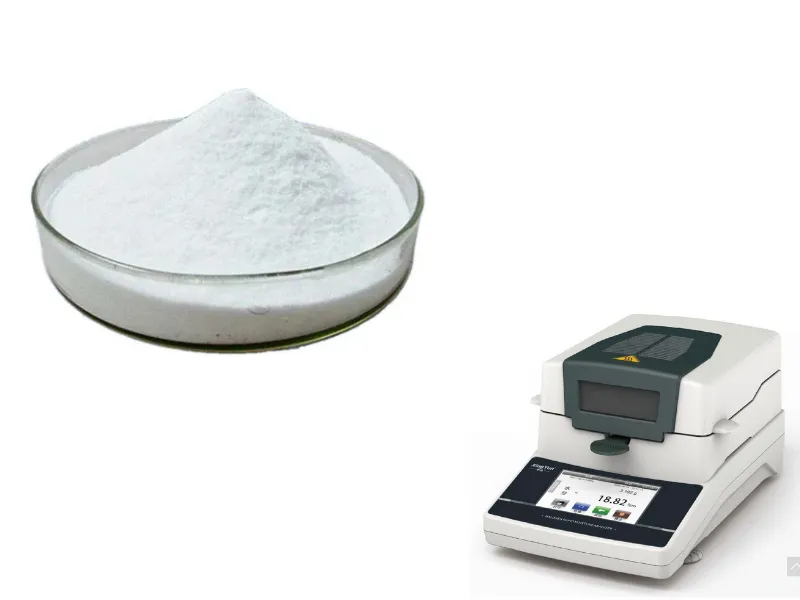
Moisture Analysis in the Chemical Industry
What is moisture analysis in the chemical industry?
Moisture analysis in the chemical industry refers to the determination of water or volatile content in raw materials, intermediates, and finished products. Depending on the specification, "moisture" may mean pure water (H₂O) or total volatiles measured by loss on drying (LOD). Accurate moisture testing is essential for ensuring product stability, compliance with pharmacopeia or industrial standards, and optimized process control.
Why is moisture testing important for chemical manufacturing?
Excess moisture can cause degradation, reduced shelf life, corrosion, or unwanted chemical reactions. Conversely, too little moisture may affect powder flowability, dissolution rates, or catalyst activity. For regulated sectors like pharmaceuticals and specialty chemicals, precise moisture determination is required to meet ICH, FDA, or ISO standards. Process engineers rely on these measurements to prevent costly deviations and ensure consistent batch quality.
What are the main methods of moisture analysis?
The chemical industry commonly applies three categories of techniques:
1. Loss on Drying (LOD) – Gravimetric method using halogen, IR, or oven drying. Measures total volatile matter.
2. Karl Fischer Titration (KF) – Volumetric or coulometric; highly specific for water content down to ppm level.
3. Near-Infrared Spectroscopy (NIR) – Rapid, non-destructive, suitable for in-line or at-line monitoring.
How does loss on drying (LOD) work in chemical labs?
LOD methods heat a sample and record mass change until stable weight is achieved. The result includes both water and volatile organics, making it suitable for total moisture determination. Halogen moisture analyzers are widely used for their rapid response, while oven methods remain standard for regulatory testing. However, LOD may overestimate water if the sample releases solvents, and care must be taken to avoid scorching or crusting.
How does Karl Fischer titration provide specific water content?
Karl Fischer (KF) titration is a chemical method where water reacts with iodine, sulfur dioxide, and an alcohol base. KF can detect moisture from 1 ppm to 100%, making it the gold standard for trace water determination. Coulometric KF suits ultra-low moisture (oils, solvents), while volumetric KF is used for higher ranges. Unlike LOD, KF quantifies only water and is widely accepted in pharmacopeias (USP <921>, EP 2.5.32).
How does near-infrared (NIR) improve process efficiency?
NIR spectroscopy measures how chemical bonds absorb specific wavelengths of light, correlating spectra with moisture levels. It is non-destructive, requires no reagents, and delivers results in seconds. NIR is especially powerful for real-time process monitoring and high-throughput screening. However, calibration models must be built and validated for each product matrix, and accuracy may depend on sample homogeneity and optics.
Comparison of Moisture Analysis Methods
| Feature | Loss on Drying (LOD) | Karl Fischer (KF) | Near-Infrared (NIR) |
|---|---|---|---|
| Parameter measured | Total volatiles | Water only | Water (calibrated) |
| Detection range | % level | ppm – 100% | ppm – % |
| Speed | Minutes | 5–20 min | Seconds |
| Sample destruction | Yes | Yes (chemical reagent) | No |
| Regulatory acceptance | Broad, pharmacopeia standard | Gold standard | Emerging, needs validation |
| Cost | Moderate | Higher (reagents) | Higher (instrument) |
What are common challenges in chemical moisture analysis?
- Sample volatility: LOD may capture solvents, overestimating moisture.
- Matrix effects: KF titration may be interfered by aldehydes, ketones, or strong oxidizers.
- Calibration drift: NIR models require routine validation against reference methods.
- Human error: Incorrect sample handling, uneven layers, or pan contamination can distort results.
How to choose the right method for your application?
- For regulatory compliance: use LOD or KF, as specified by pharmacopeia or ISO.
- For trace-level water: choose Karl Fischer (ppm detection).
- For fast screening / in-line control: apply NIR, with validated calibration.
- For routine QC: halogen-based LOD is cost-effective and accurate.
Real-world applications in the chemical industry
- Pharmaceuticals: moisture affects tablet stability, disintegration, and storage.
- Polymers and plastics: residual moisture influences extrusion quality.
- Catalysts and powders: precise water content is critical for reactivity.
- Specialty chemicals: solvents and hygroscopic compounds require strict control.
Key takeaways
Moisture analysis in the chemical industry is not one-size-fits-all. LOD provides general volatile content, Karl Fischer delivers precise water quantification, and NIR enables rapid, non-destructive process monitoring. The right method depends on sample type, regulatory requirements, and throughput needs. Combining techniques often provides the best balance of accuracy, compliance, and efficiency.
FAQ
Q1. What is the most accurate method for moisture analysis in chemicals?
Karl Fischer titration is the most accurate for water determination, as it measures water directly down to ppm levels, while LOD and NIR may include volatiles or require calibration.
Q2. Can NIR replace Karl Fischer or LOD?
NIR is excellent for rapid, routine monitoring but must be calibrated against KF or LOD. It cannot fully replace reference methods in regulatory contexts.
Q3. Why does LOD sometimes overestimate water?
LOD records all volatile loss, not just water. Samples containing alcohols, solvents, or low-boiling compounds may show inflated moisture results.
Q4. Which method is best for regulatory compliance?
Both LOD and KF are widely accepted by pharmacopeias and ISO standards. NIR can support compliance but usually requires validation against KF or LOD.
Q5. How often should instruments be calibrated?
LOD analyzers should be calibrated quarterly with reference weights. KF titrators require frequent reagent standardization. NIR models need recalibration whenever sample formulation changes.